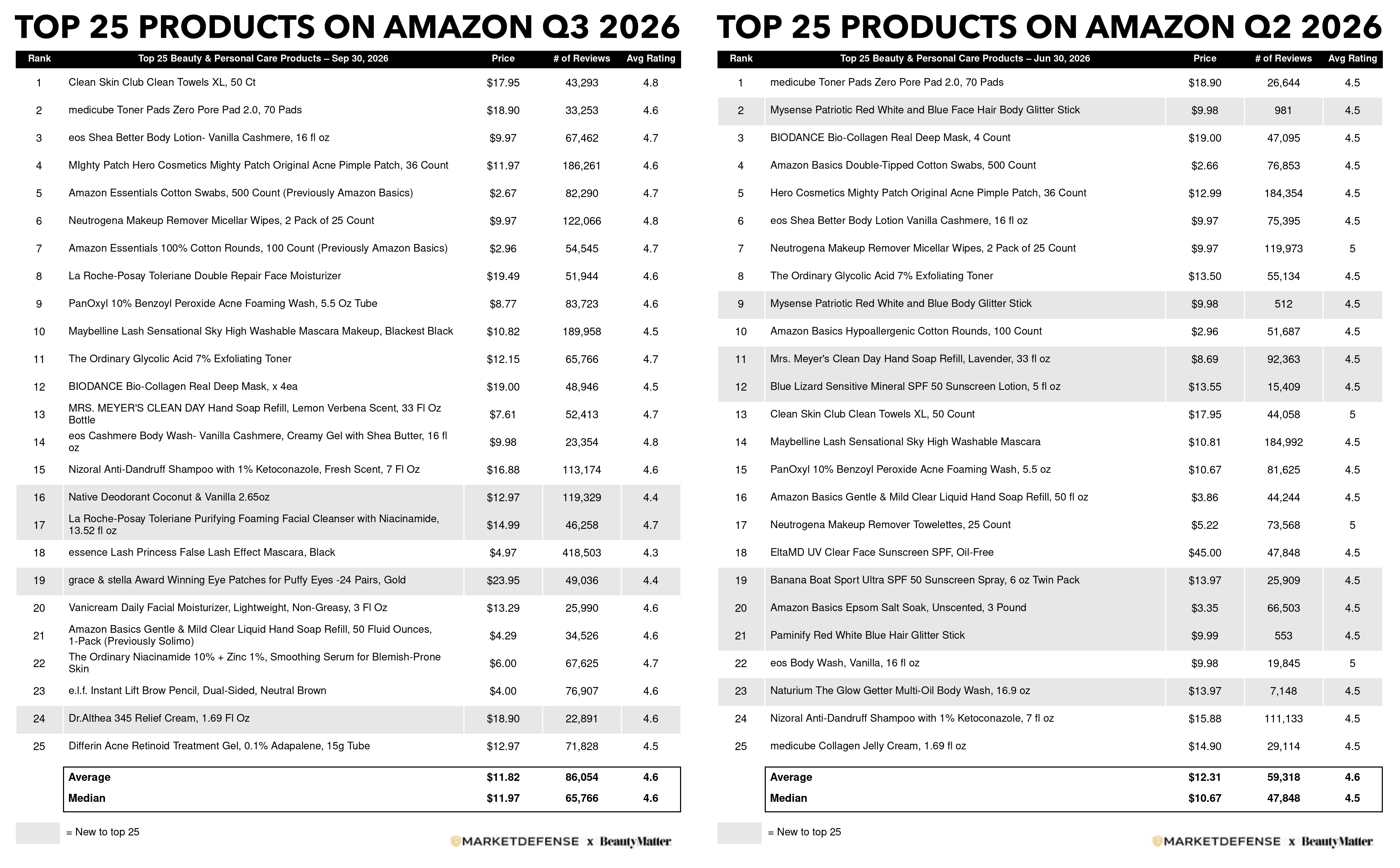
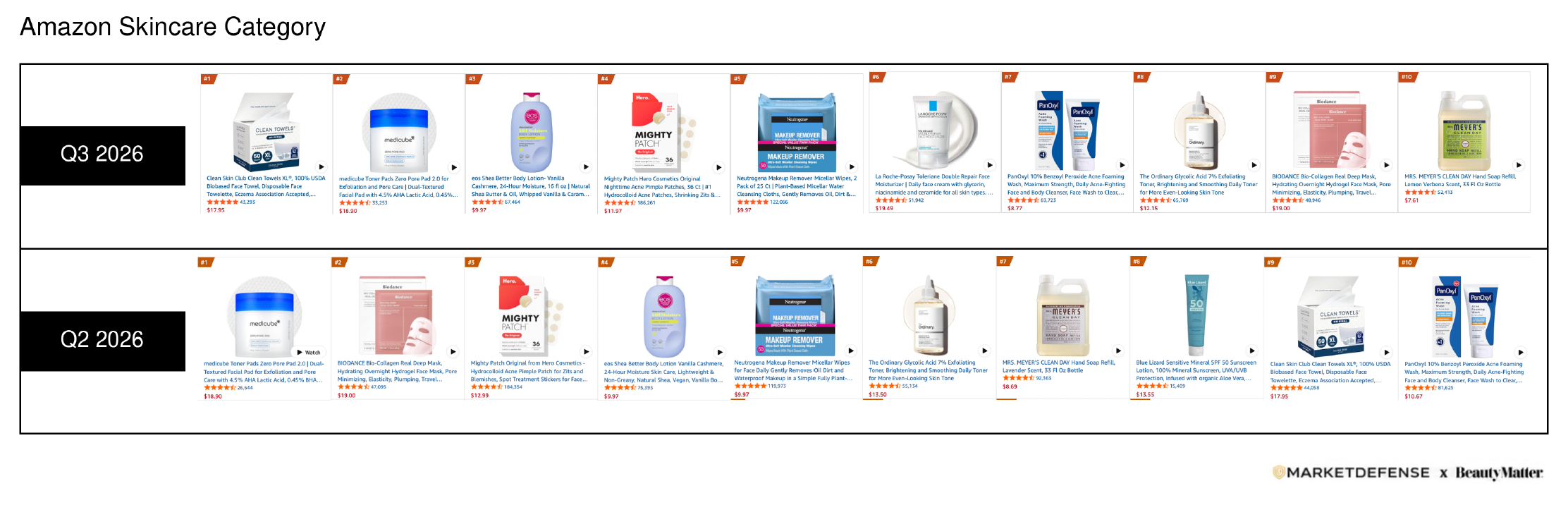
Leading the list of 25 top-selling Beauty & Personal Care products of Q3 2026 was Clean Skin Club Clean Towels XL, which made a clean sweep up the chart, climbing 12 spots from #13 to take #1 for the first time after four quarters at #2. Medicube Toner Pads Zero Pore Pad 2.0 slipped to #2 after two consecutive quarters at #1, even as the K-beauty giant's review count grew by 25% in three months. Eos Shea Better Body Lotion, Vanilla Cashmere (#3), Hero Cosmetics Mighty Patch Original Acne Pimple Patch, 36 Count (#4), and Amazon Essentials Cotton Swabs, 500 Count (#5) rounded out the Top 5.
According to Amy Rudgard, SVP of Client Strategy at Market Defense, it's no surprise that Clean Skin Club’s Towels XL climbed to the top of the bestseller list during a quarter when shoppers stocked up on cleansing and clear-skin essentials. “The back-to-school and dorm room essentials saw a 10%-15% lift over Q2, while the brand's own search interest was down year over year,” Rudgard said. Paid media, either on or off Amazon, or likely both, fueled Clean Skin Club’s XL rise to the top, she said.
“It's a smart solution for what Gen Z shoppers want in a dorm routine: easy, clearer-skin solutions in a more sustainable, biobased format. The takeaway? This may slow down into Q4, but brands should be ready when demand for cleansing products returns in January, when we've seen searches rise by as much as 30% vs. December," according to Rudgard.
Four products made their first appearance in the Top 25 this quarter: Native Deodorant Stick Coconut & Vanilla (#16), La Roche-Posay Toleriane Purifying Foaming Facial Cleanser with Niacinamide (#17), Grace & Stella Award-Winning Eye Patches for Puffy Eyes (#19), and Dr. Althea 345 Relief Cream (#24). Native arrived with 119,329 reviews, more than the other three newcomers combined.
The average price point of the Skincare Top 10 was $13.58, up 0.5% from last quarter.
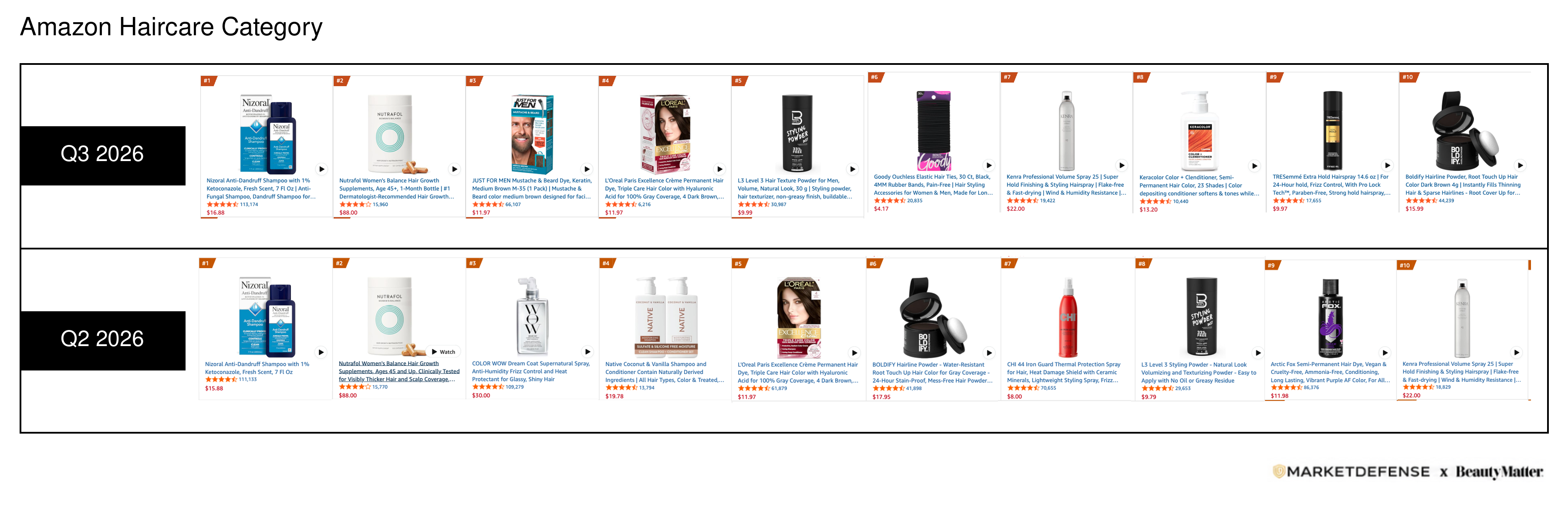
The average price point of the Haircare Top 10 was $20.41, down 13.3% from last quarter.
The average price point of the Makeup Top 10 was $8.66, up 2.3% from last quarter.
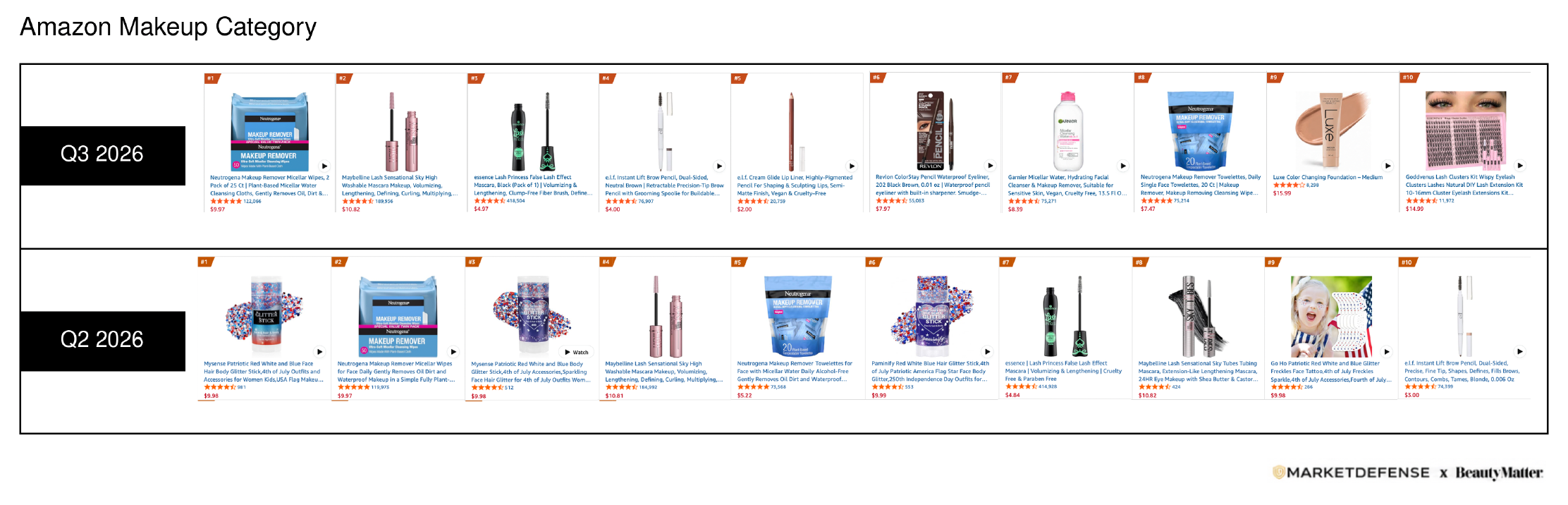
The summer party is over. Ten products left the list, and the loudest exits were the guests of Q2's celebration: three patriotic glitter sticks that rode the World Cup in the US to #2, #9, and #21 on just 981, 512, and 553 reviews, and all three of the sunscreens that filled beach bags, which went from one placement in Q1 to three in Q2 to zero as the season turned.
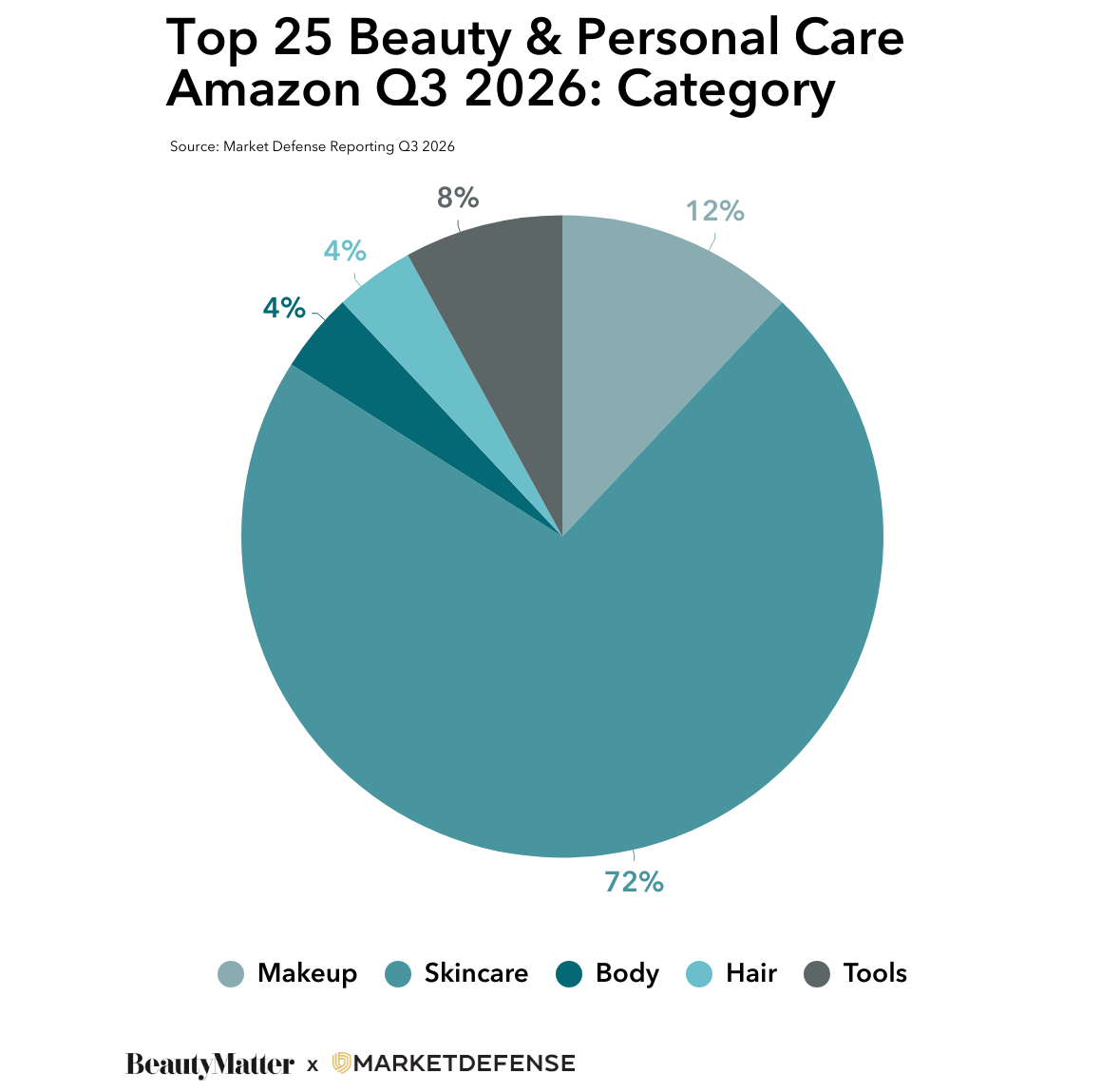
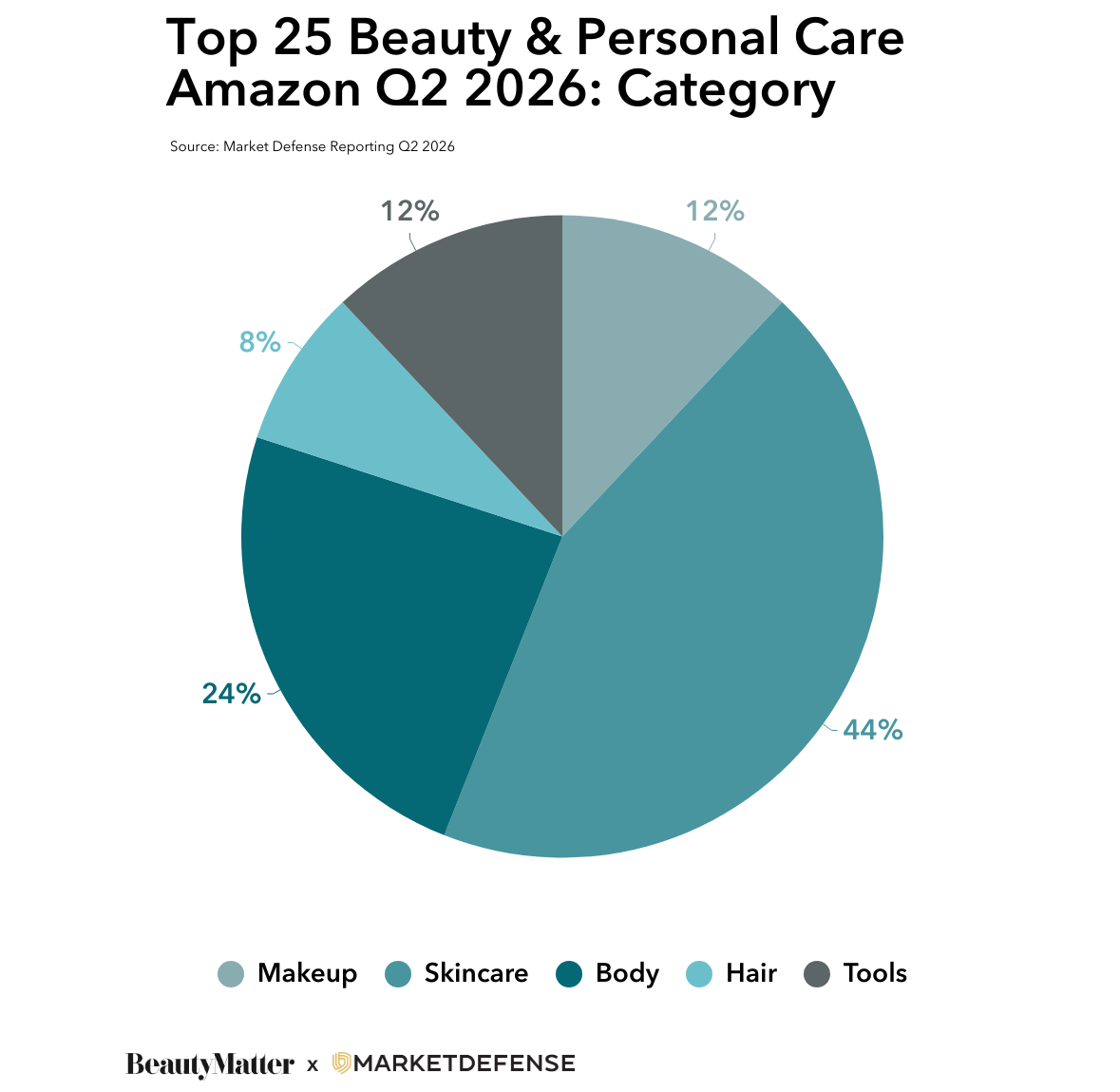
This quarter, eight of the 25 products on the chart are formulated and marketed to address a specific problem, such as acne, dandruff, enlarged pores, or dark circles, making them the most problem-solution-specific products in any quarter since Market Defense began tracking the Amazon Top 25 in Q2 2021. The personal care pantry items shoppers have long used Amazon to restock, such as cotton swabs, hand soap, and body lotion, fell to 14 of the 25 spots, the fewest of any quarter Market Defense has tracked.
By Market Defense’s count, the eight top problem-solvers are Medicube Toner Pads Zero Pore Pads (#2), Hero Cosmetics Mighty Patch (#4), PanOxyl 10% Benzoyl Peroxide Acne Foaming Wash (#9), Nizoral Anti-Dandruff Shampoo (#15), Grace & Stella Eye Patches (#19), The Ordinary Niacinamide 10% + Zinc 1% for Blemish-Prone Skin (#22), Dr. Althea 345 Relief Cream (#24), and Differin Adapalene Gel (#25).
Each of those eight spots reflects a shopper’s search, and the words they use determine which products get seen and ultimately bought. "Brands who are looking to acquire new customers need to know what search behavior is driving purchases on Amazon,” said Jonathan Wilner, SVP of Commerce Media at Market Defense. “The meaningful growth could be share you take from a competitor, by name, because the shopper typed yours instead of theirs."
It is clear customers purchase problem-solution products on Amazon in big numbers, but how do they find them in the ocean of more than 350,000 beauty products? Are they searching by problem or solution? The answer is both, and they usually search for them together. Looking at every Amazon search that contains each problem word, the most-searched unbranded term in each category pairs the problem with the format that treats it. The eight problem-solvers on the Top 25 name themselves the same way, such as Mighty Patch Original Acne Pimple Patch, Nizoral Anti-Dandruff Shampoo, and Medicube Toner Pads Zero Pore Pads.
In pimple patches, the two-word search "pimple patches" is the top search by far, accounting for about 70% of the category's searches, or 1.7 million a month, roughly eight times the next-largest search. In dark circles, "eye patches for puffy eyes and dark circles" is the top search at 24%. Acne is more spread out: "acne patches" is the top search there too, but at only 6% of the category's searches, barely ahead of the next biggest, with the rest split among acne face washes, acne spot treatments, and brand names. In dandruff, "dandruff shampoo" is the top unbranded search term, accounting for roughly 23% of the category, behind only the Nizoral brand name.
Educated shoppers know sometimes the solution is a specific ingredient. They enter the ingredient they have learned about on social media, or already trust to fix the problem, directly into the search bar. The shift toward ingredients shows up in Market Defense's Prime Day 2026 data too: Searches for face concerns fell by 6.4% globally, while ingredient searches, such as TikTok-trending NAD toner and NAD eye cream, each grew by more than 1,000%.
In skincare, shoppers type the ingredient into the search bar far more often than they search for the problem it treats. In facial serums, searches for the ingredients "retinol," "azelaic acid," and "niacinamide serum," all known to treat problems like rosacea, hyperpigmentation, and melasma, together draw about 16 times as many searches as the problem searches "rosacea treatment for face," "hyperpigmentation treatment," and "melasma treatment" combined.
"Take 'rosacea treatment for face.' It draws about 26,000 searches a month, and only 32 brands are on it. You have a much better chance of getting found, and getting the sale, when you aren't fighting hundreds of other brands for the same shopper," said Dave Karlsven, SVP of Partnerships & Growth at Market Defense.
“Brands who are looking to acquire new customers need to know what search behavior is driving purchases on Amazon,” saidKarlsven. “The meaningful growth could be the share you take from competitors who are not protecting their top searched terms, or optimizing for the nonbrand terms that Amazon auto suggests because of the higher sales volumes they often come with."
Acne shoppers search this way, too, when it comes to the classic pimple fighter, benzoyl peroxide, according to Karlsven. About half of all Amazon searches that include the ingredient are just "benzoyl peroxide," with no other search terms, and that search has increased by about 22% over the last 12 months. The next biggest search adds the format "benzoyl peroxide wash" to the ingredient and draws only about one-fifth as many searches.
Hair regrowth is a three-way tug-of-war between searching by ingredient, by brand, or by the problem itself, and the ingredient wins, accounting for 55% of the volume among the 15 biggest searches, followed by the brand at 36% and the problem at just 9%. Six of those 15 searches name an ingredient, led by "minoxidil for men," which alone draws more than a quarter of the volume, and "ghk-cu peptide hair" at 13%. Six searches name a brand, led by "Mary Ruth multivitamin hair growth" and "Nutrafol women hair growth supplement" at 14% each. Only three name the problem itself, and the biggest, "hair growth," draws just 4%. Searches that mention women flip the order: The brand search "Nutrafol women hair growth supplement" draws about twice as many searches as the ingredient search "minoxidil for women."
Some shoppers already know the brand they want and type it straight into the search bar. Dandruff is the clearest case of a category where the brand name is the search. Nizoral's name appears in 42% of dandruff searches on Amazon, more than the 35% that name no brand at all, and searches for "Nizoral anti-dandruff shampoo" are up about 27% year over year. Head & Shoulders, a household name, accounts for only about 3%.
Brand search is growing across all beauty categories. Searches that name a brand drove 20.2% of estimated beauty purchases on Prime Day 2026, up from 17.4% a year earlier, or about one in five purchases. "Brands with a large volume of high-converting brand search traffic on Amazon are rewarded heavily in the algorithm across the best paid and organic placements on the top searched keywords," said Karlsven. "But you can't assume that you will convert on those branded search terms just because the shopper is familiar with you; you still need to reach through the screen and connect with them all the way to purchase."
1. Check which side your category is on. "Pull the top search term in your category and see how much of it carries a brand name. If it's mostly unbranded, invest in the generic keywords and the reviews that convert them. If a brand name dominates, defend yours first, then decide whether to compete on the incumbent's terms," said Wilner.
2. Start with the generic search. "Put the problem and the format in your title and the first lines of your listing, because that is exactly what shoppers are typing. Then go where the demand is and bid on those generic terms. The real opportunity is finding search terms for problems your product fixes where thousands of shoppers are looking and very few brands are showing up," said Karlsven.
3. Know the problem your customer wants solved by surveying buyers, reading reviews, and tracking search and social trends. "For example, Just For Men surveyed younger men and learned 68% care more about their appearance than five years ago, and gray ranks among their top aging concerns. They shop where it's easy: Amazon takes 54% of men's grooming budget, and searches for beard dye are up nearly 40%. Years ago, I launched an award-winning airbrush root touch-up that worked beautifully on beards and gray, but mostly stylists noticed. The mainstream man wasn't there yet. Now he is," said Rudgard.
Previous Reports:
Q2 2026 Amazon Top 25 Beauty & Personal Care
Q1 2026 Amazon Top 25 Beauty & Personal Care
Q4 2025 Amazon Top 25 Beauty & Personal Care
Q3 2025 Amazon Top 25 Beauty & Personal Care